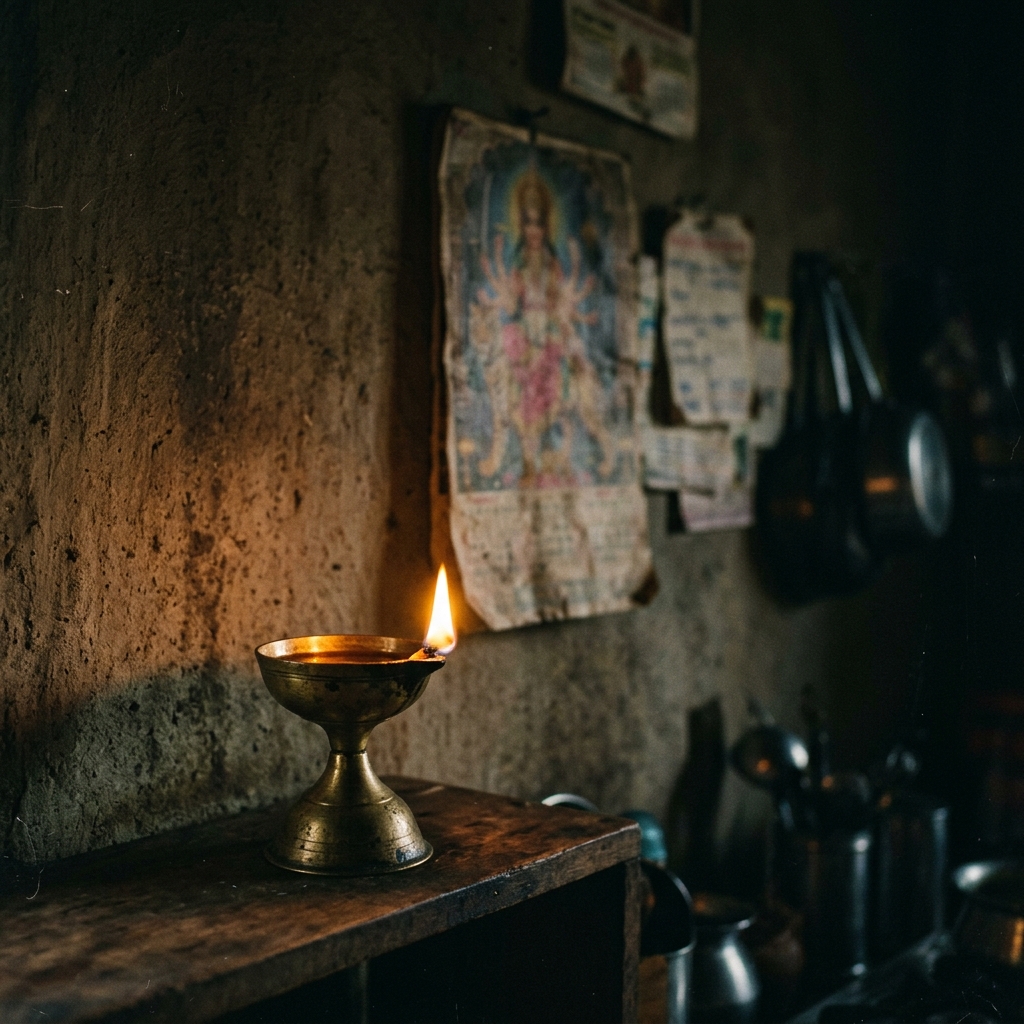
There is a goddess in your house right now.
If you grew up where I did, you know her. She came free with the January calendar from the grocery shop. She watches the kitchen from between the electricity bills and the school timetable. And before your family moved into that house — before the beds, before the gas connection — someone built her a mandir in the wall.
Nobody decided this. It was simply done. The way breathing is done.
I loved her. I still do, in a way that will take me a whole book to explain.
But I have to say something now, and I have rehearsed it for years without once saying it out loud:
I don't believe she is there.
And I am not an atheist.
I know. Both camps just rolled their eyes. The believers are reaching for my childhood. The rationalists are reaching for their favorite word — finally, he's one of us. I'm sorry. I am neither. I checked.
Here is what actually happened. For years I did everything correctly. Lit the diya. Folded the hands. Asked. Waited.
Aur main wahin khada rehta tha. Routine poori. Haath jude hue. Aur andar ek hi sawaal —
I would finish the aarti and stand there doing the mathematics of a miracle, and the mathematics never worked. Not once.
Most people who reach this point pick a door. Temple, or exit.
I stood in the doorway for twenty years.
The book I am writing is about what I found there. It is called Mirage and Mirror: The God We Created, the Self We Are.
Mirage — because the gods on our walls are not lies. A mirage is a real optical event. The water isn't there, but the image is, and the thirst is, and sometimes the image walks a dying man one more mile to a real well. What do you call that kind of truth? I don't know yet. That's why the book.
Mirror — because when the image faded, God did not leave. He left no forwarding address in the sky. He had moved somewhere closer. Into certain rare moments — when something righteous acts through you, and the you that acts is not the anxious, calculating one. That one just watches.
I stopped believing in God as a noun. I am learning to trust God as a verb.
— Mirage and Mirror, AshVaani
Kabir is in this book. So is a German monk who prayed to God to free him of God. Same moon. Different waters.
I don't know how the book ends. I am writing it to find out.
But if you have ever stood in front of a god with love in one hand and doubt in the other — with the diya still burning — this is being written for you.
Main bhi wahin khada hoon.
Diya jal raha hai. Darwaza khula hai.
— Ash
The questions that never arrive inside temples — sometimes they find their way into books. This one is being written now.
Explore the Books