Hello Fellas,
I found it under a stack of old income tax returns and empty mobile phone boxes. A brown notebook with a black spiral spine. The cardboard cover had warped from the Delhi monsoon years ago, and the pages had turned the color of weak tea.
The handwriting was mine. Or, at least, it belonged to a hand that shared my bone structure. The ink was that specific royal blue of a Pilot V5 pen that I used to buy in bulk from the stationery stall outside the metro station. But the person who wrote those lines? I don’t know him.
He had written lists. A budget that counted every fifty rupees with the desperation of a man trying to land a rover on Mars. A list of goals for the winter of 2015: Buy a brown leather wallet. Learn Python. Save fifteen thousand rupees. Write three pages every morning. Why did R. not reply to my message?
I read those pages sitting on the floor of my bedroom, surrounded by the debris of a weekend cleanup. I wanted to feel something—nostalgia, warmth, maybe a quiet amusement at his innocence. But there was only a flat, sterile silence. If that twenty-two-year-old boy walked into this room right now, what would we say to each other?
We would sit on opposite ends of the sofa and stare at our tea. I would find his worries—his frantic obsession with saving fifteen thousand rupees, his agony over a delayed text message—incredibly small. And he? He would look at my compromises, the things I decided to live with, the dreams I quietly folded and put away in the drawer, and he would find me unforgivable.
He would see me as a traitor. I see him as a child. That is the distance.
वो जो पन्नों पर रह गया, वो मैं नहीं था। वो सिर्फ एक कहानी थी जिसे मैंने बहुत पहले जीना बंद कर दिया।
The one who remained on those pages is not me. He was just a character in a story I finished reading a long time ago. And yet, we spend our entire lives pretending that the character and the reader are the same person.
The Trap of Consistency
All modern literature, self-help, and therapy seem obsessed with one goal: knowing yourself. They talk about "finding your true self" as if you are a set of keys dropped behind the sofa cushions. They tell you to remain consistent, to hold on to your roots, to remember who you were when you started.
But they never warn you about the cost of that consistency.
We carry our past selves around like heavy, antique furniture. We drag them from one rented apartment to the next, scraping the walls, hurting our backs, simply because they belonged to our family or because we paid a high price for them once. We feel a strange guilt when we realize we don't care about the things we used to die for.
If you wanted to be a filmmaker at twenty, and at thirty-five you just want to grow tomatoes and sleep by ten, the world calls it a failure of ambition. We call it "settling." But what if it isn’t settling? What if it is just the natural erosion of a dream that was never yours to begin with, but belonged to a version of you that no longer exists?
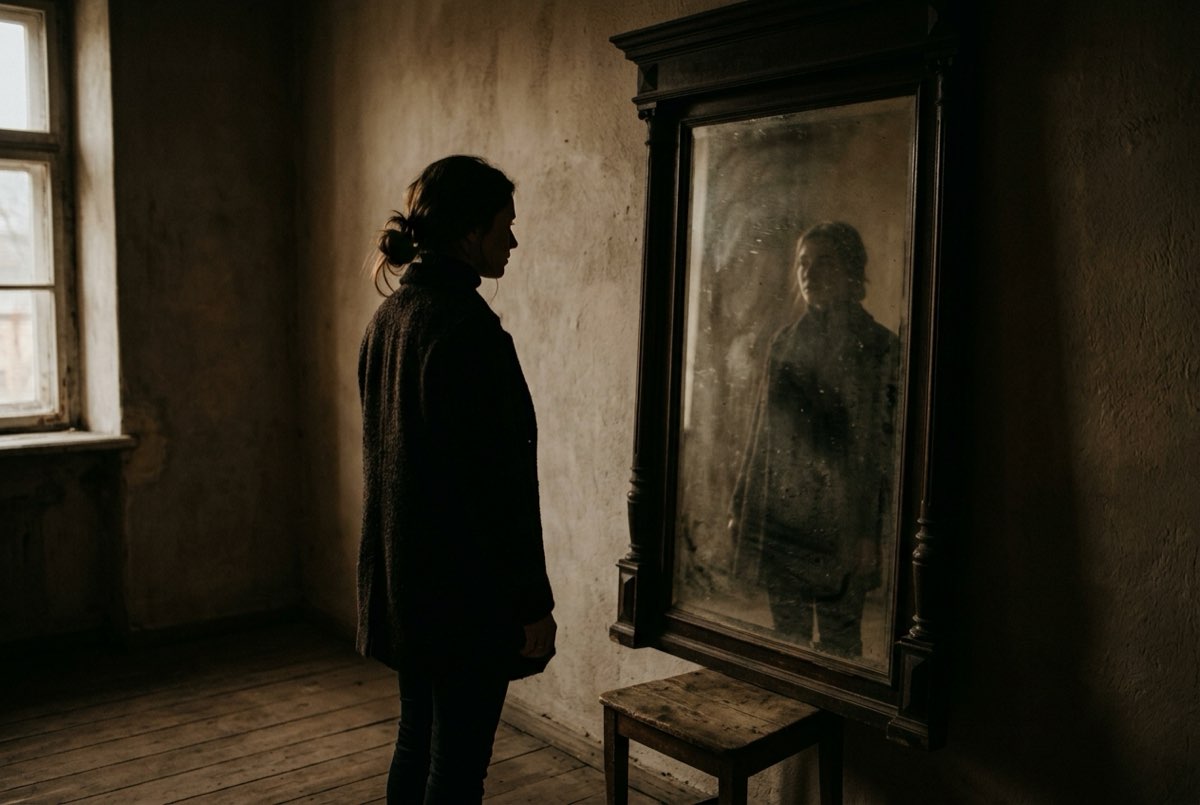
Why should you be loyal to the wishes of a dead man? Because that is what your past self is. A ghost who had less information than you, less experience than you, and a completely different set of fears. Letting him run your household is a very strange way to live.
"अपनी ही परछाईं के पीछे भागना बंद करो। वो बस धूप का खेल है, तुम्हारी हकीकत नहीं।"
There is a peculiar freedom in realizing you don't owe your past self anything. Not your career, not your political opinions, not even your style of writing. You don't have to defend the arguments you made five years ago. You don't have to pretend to love the books you outgrew just because you wrote a glowing review of them once.
The Geometry of Kabir
There is a couplet by Kabir that I keep coming back to whenever I feel the weight of this false identity. It’s one of those verses we are taught in school, repeated until the words lose their teeth, and then, years later, the meaning hits you like a brick in a dark alley:
जब मैं था तब हरि नहीं, अब हरि हैं मैं नाहिं।
प्रेम गली अति सांकरी, तामें दो न समाहिं।
We are taught that this is about devotion—about losing the ego to find God. But if you look at the geometry of it, Kabir is talking about space. "Prem gali ati saankari..." The lane is too narrow. It cannot hold two.
It doesn't just apply to God and the ego. It applies to your history and your present. The room of the present moment is a very narrow lane. You cannot fit both your memory of who you are and the reality of what is in front of you. One of them has to leave. If you are constantly performing the version of "you" that you have constructed over thirty years, you are too crowded to see anything else.
To see the tree in front of you, you must forget that you are a person who dislikes trees. To listen to the person across the table, you must momentarily abandon the history of every argument you have ever had with them. You must become a stranger to your own assumptions.
In Hindi, we have this word: अजनबी (Ajanabi). It is a beautiful word. It doesn’t just mean someone you don’t know. It means someone who has become foreign. It comes from the Arabic root janb, meaning side or margin. An *ajanabi* is someone who stands on the edge, looking in.
Learning to stand on the edge of your own life is the beginning of sanity. It is the realization that you are not the house; you are just the one living in it. You don't have to protect the walls from changing their color.
The Unforgiving Forgiveness
This brings me to the hardest part of this transition: self-forgiveness.
We all have things we did in our twenties—or even last winter—that make us wince when we remember them in the middle of the night. The phone call we didn't make. The friend we let slip away because of pride. The time we stayed silent when we should have spoken, or spoke when we should have listened.
We are told to "forgive ourselves." But how do you forgive a person you no longer are? The person who made that mistake had different tools, a different panic, a different ignorance. You cannot forgive him because you cannot reach him. He is out of your jurisdiction.
जिसे तुम माफ़ करना चाहते हो, वो तो अब उस पते पर रहता ही नहीं।
The person who did those things is gone. Trying to forgive him is like trying to pay a debt to a shop that closed down ten years ago. You just have to let the ledger close. You have to allow that boy to be a stranger who made a mistake in a country you no longer inhabit.
He was foolish. He was scared. He had bad taste in shoes and worse taste in arguments. But he did the best he could with the small window of light he had. Let him rest. You don’t need his permission to be different today.
The hardest person to let go of is not the one who broke your heart. It is the version of you that let them do it.
— The Price of Loyalty, AshVaani
The Room We Leave Behind
I closed the brown spiral notebook and put it back in the cardboard box. I didn’t burn it—that would be too dramatic, a performance of letting go that actually clings to the importance of the object. I just put it back at the bottom of the wardrobe, behind the spare bedsheets.
It is there if I ever need to verify a date or remember the price of a metro token in 2015. But it is no longer a contract. I am under no obligation to fulfill the promises written in that blue ink.
We are not monuments. We are not built to stay vertical and unchanged against the weather. We are forests—constantly dropping dead leaves, growing new bark, turning towards the light, and forgetting the shape we had last winter.
It is okay if people who knew you five years ago say you have changed. It is okay if they find you unfamiliar. That is not a failure of character; it is a sign of life.
अजनबी होना कोई निर्वासन नहीं है। यह तो बस थोड़ी जगह बनाना है।
— Ash
If you're exploring the gaps between who you were, who you perform as, and who you are in the quiet spaces, check out Ash's books.
Explore Beech Ka Aadmi